A speculative motion campaign introducing South Korea's top-rated functional haircare brand to a North American audience — through the lens of a generation raised on glossy pop culture and obsessed with their hair. As a creative partner at Dreamina AI, I created this case to show how AI-assisted motion direction can translate a brand strategy into a cinematic campaign system.
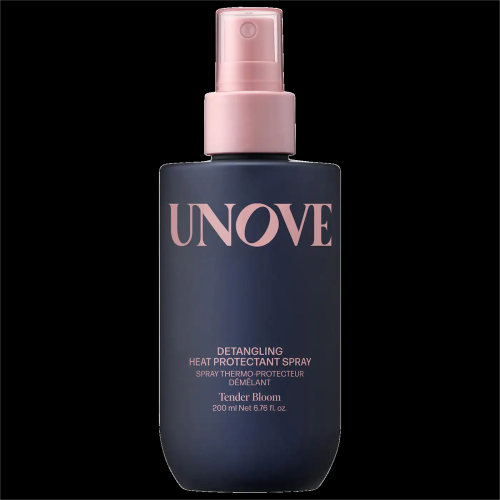
UNOVE is arguably the best functional haircare brand in South Korea. Nobody in North America knows it exists.
Before concepting a single frame, I spent time understanding what UNOVE actually is — and why it deserves a Western audience. UNOVE has built its reputation on one thing: genuinely repairing damaged hair at a molecular level, not just coating it. Their hero product, the Deep Damage Treatment EX, uses a concentrated protein complex developed through dermatological research. It's the kind of product that turns skeptics into loyalists — if only they'd heard of it.
That gap between product efficacy and brand awareness in North America was the brief I wrote for myself. UNOVE's visual identity — deep navy packaging, soft pink typography — already reads as premium and fashion-forward. It just needs a cultural bridge to land with an American audience.
The campaign isn't for everyone with hair. I identified a specific psychographic: North American women aged 18–28 who grew up on early-2000s pop culture, lived through the era of heat tools, box dye, and bleach — and are actively trying to undo the damage. They're already converted K-beauty skincare users. Getting them to make the leap to K-beauty haircare was the real creative challenge.
This audience doesn't respond to clinical before/after imagery. They respond to culture. The insight driving the campaign: they grew up consuming fashion, aspiration, and drama through the lens of glossy pop culture moments that felt both over-the-top and entirely sincere — the kind of early-2000s girl-group energy that defined a whole aesthetic era.
The campaign translates that cultural vocabulary into a K-beauty beauty moment. The visual language borrows from the hypersaturated confidence of Y2K fashion: bold saturated colour, expressive faces, dramatic hair, unapologetic femininity. UNOVE is the product those characters would have sworn by — the salon-grade secret weapon behind every perfect hair moment.
Two films, two moments in the same emotional journey. Both were directed and produced independently using Dreamina AI for motion generation, with additional colour grading and timing refinement. Each targets a distinct beat — the damage reality that every girl in this audience knows, and the transformation that UNOVE delivers.
Producing a cinematic beauty campaign without a studio, crew, or talent budget requires a different kind of creative problem-solving. As a creative partner at Dreamina AI, I wanted to show how the tool can support a real creative-director workflow: research, concept, visual language, prompt direction, grading, and final campaign rhythm. The skill required is precision of visual language: the ability to describe exactly what you see in your head in terms a generative system can realise.
This project began with a question I couldn't stop thinking about: why isn't UNOVE everywhere in North America already? The product genuinely outperforms most of what's on Western shelves. The answer is that Korean brands default to marketing within Korean cultural contexts — brilliant at home, but requiring a deliberate bridge to reach an audience that hasn't been introduced to the brand ecosystem yet. That bridge is culture, not product specs.
Operating as a one-person creative team — strategist, director, and motion designer simultaneously — forced a clarity of thinking you only develop when there's no one else to defer to. Every decision had to be defensible on its own terms. That constraint sharpened the work considerably.
Working with Dreamina AI shifted my understanding of what creative direction actually is. The technical skill matters less than the precision of your visual imagination — the ability to describe exactly what you see and feel in language clear enough for a generative system to realise it. That's a genuinely transferable design capability, not a shortcut around craft.